How do you recognize arthritis in an older dog?

"He's just getting old." That's the most common — and most incorrect — diagnosis for dogs that are slowing down. In reality, an estimated one in five adult dogs has osteoarthritis, and for dogs over eight years old, that number is even higher. The good news: the earlier you recognize it, the more you can do about it. And now that the nights in Belgium are getting cooler and wetter again, the first complaints often surface.
📌 In short
- Osteoarthritis is the wear and tear of joint cartilage — chronic, painful and incurable, but manageable.
- The clearest early sign is stiffness after rest that disappears once your dog gets moving.
- Other signs: hesitation on stairs, no longer jumping into the car, licking a single joint, irritability.
- Weight control is the most important measure: every extra kilo puts additional strain on every joint.
- Stay active, but more often and shorter instead of one long weekend walk.
What exactly is osteoarthritis?
Osteoarthritis (osteoarthritis) is the gradual wearing away of the cartilage that protects the ends of bones in a joint. Without that buffer, the bones rub together, the joint becomes inflamed, and movement becomes painful. It most often occurs in the hips, knees, elbows, and spine.
What are the 8 signs of osteoarthritis?
- Stiffness when getting up after sleeping or a long car ride, and walking more smoothly after a few minutes.
- Hesitation before stairs, the car, or the couch — or outright avoidance.
- Wanting shorter walks or lagging behind on the way back.
- Changed gait: small steps, "hopping" with the hindquarters, bunny hopping.
- Licking or nibbling a single spot above a joint.
- Muscle loss in the hindquarters while the shoulders appear stronger.
- Becoming irritable or withdrawn, especially when touched or lifted.
- Sleeping more and playing less spontaneously.
Don't confuse it with paw problems: a dog licking one paw could just as easily have a grass awn or skin problem. See Why does my dog constantly lick his paws?
Which dogs are most at risk?
| Risk factor | Why it plays a role | What you can do about it |
|---|---|---|
| Overweight | More strain and more inflammation-promoting substances from fat tissue | Weigh portions, deduct snacks from the daily ration |
| Large breeds | Heavier joint strain, more often hip or elbow dysplasia | Early screening, controlled growth in puppies |
| Age over 8 years | Cartilage heals slower | Annual to semi-annual check-up |
| Old injury or surgery | Changed joint load | Physiotherapy, muscle building |
| Slippery floors | Slipping causes shock load and fear of movement | Runners or non-slip mats on walking routes |
Why is weight so crucial?
Of all measures, weight loss has the greatest proven effect on pain and mobility — often greater than supplements. The tricky thing is that a dog with osteoarthritis moves less and therefore gains weight more easily: a vicious circle.
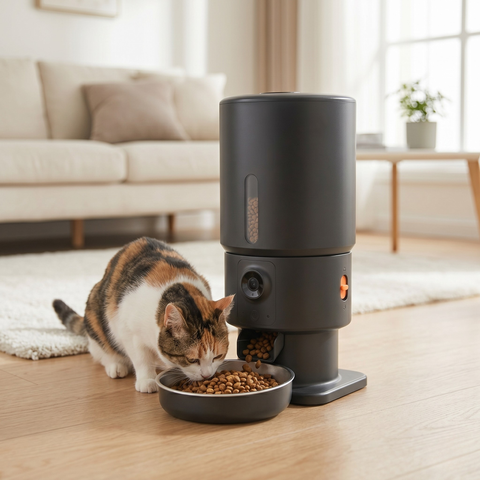
Fixed, weighed portions at fixed times keep this under control, even if you are not home during the day. Calculate your daily ration with How much food does my dog need per day?

ChromeFeeder — 2L automatic feeder (wifi)
Exact portions at fixed times via the app. Useful for closely monitoring the weight of a dog with osteoarthritis — even when you're at work.
View product →How much exercise does a dog with osteoarthritis need?
Movement remains essential: rest makes joints stiffer and muscles weaker. The rule is more often and shorter — for example, four twenty-minute walks instead of one two-hour walk. Avoid wild sprints, throwing balls, and abrupt turns. Swimming and gentle walking on soft ground are ideal.
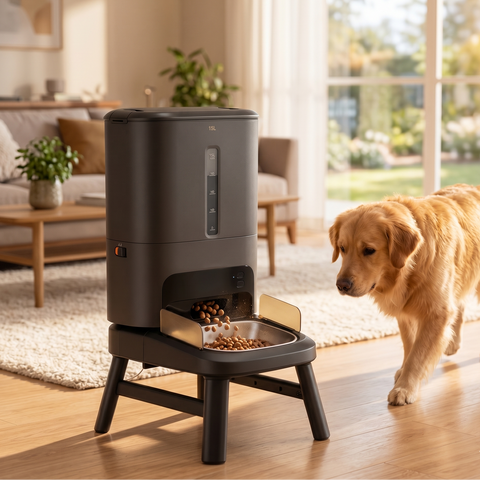
💡 Tip: Place water and food on a raised platform so your dog doesn't have to bend down deeply. A dog that experiences less pain when drinking will drink more — and that is especially important for older dogs' kidneys.
Wondering if your dog is getting enough? Read Does my dog drink enough water?
⚠️ Never give human painkillers
Ibuprofen, diclofenac, and paracetamol are toxic to dogs and can cause stomach bleeding, kidney, and liver damage. Pain relief should only be administered with a prescription from your veterinarian, who will adjust the dose based on weight, kidney values, and age.
What can your vet do?
A clinical examination, possibly X-rays, and then a customized plan: anti-inflammatory drugs, painkillers, injections with joint protectors, physiotherapy, or adapted diet food. Laser treatment and hydrotherapy are also increasingly offered in Belgium.
FAQ about osteoarthritis in dogs
At what age do dogs get osteoarthritis?
Usually from 7 to 8 years old, but in large breeds or after a joint injury, it can start much earlier — sometimes around 2 years old.
Do glucosamine or green-lipped mussel really help?
Study results vary. They can be supportive, but do not replace pain management or weight control. Consult your vet.
Does osteoarthritis get worse in cold or damp weather?
Many owners notice that their dog is stiffer in cold and damp conditions. Provide a warm, draft-free, and well-padded bed.
Can a dog with osteoarthritis go up stairs?
Preferably as little as possible, and certainly no running down. A ramp or assistance with lifting spares the joints.
What is the difference between osteoarthritis and hip dysplasia?
Hip dysplasia is a congenital malformation of the hip joint; osteoarthritis is the wear and tear that often follows. They therefore frequently occur together.
SmartPaw editorial team — facts checked with veterinarians and official sources (Merck Veterinary Manual, American College of Veterinary Surgeons, WSAVA Global Nutrition Guidelines).
Published on August 26, 2026 · Last updated on August 26, 2026.
This blog is for informational purposes only and does not replace veterinary advice.
Meer uit dit onderwerp

Waarom lekt mijn drinkfontein en hoe los je het op?
Plas water onder de drinkfontein van je kat? Ontdek de 7 meest voorkomende oorzaken van lekken en los...

Hoe vaak moet je je hond of kat ontwormen?
Hoe vaak ontworm je je hond of kat? Ontdek het schema per leeftijd en leefstijl, de symptomen van...

Waarom heeft mijn hond diarree en wat doe je eraan?
Diarree bij je hond? Ontdek de 8 oorzaken, wat je de eerste 24 uur doet, wanneer je moet...
Iets nodig voor je huisdier?
Onze fonteinen, voerbakken en de FurVac zijn gemaakt om je tijd te besparen en je huisdier gelukkiger te houden.
Naar de shop